Managing people at work has undergone significant changes.
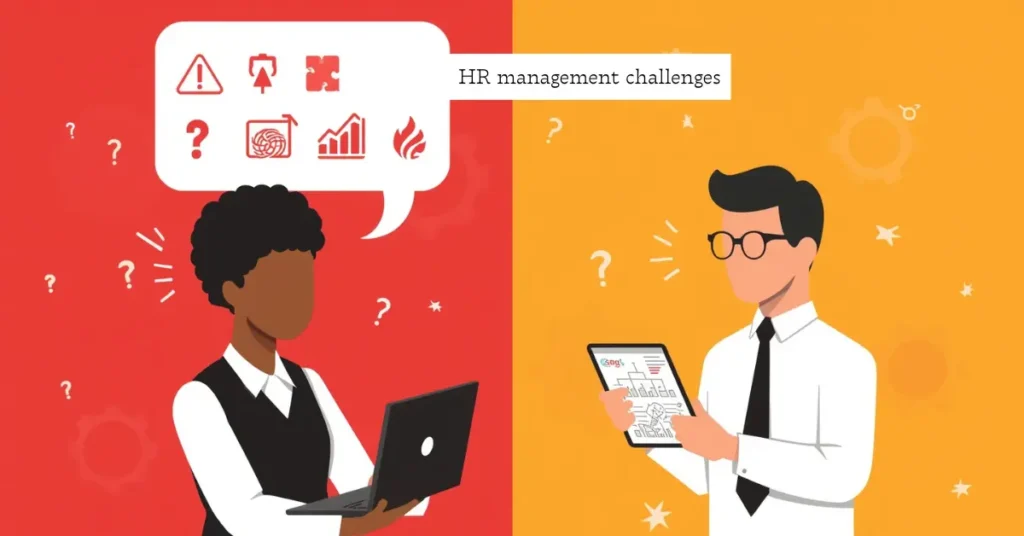
Companies today face major HR management challenges that didn’t exist five years ago.
Your HR team can’t just handle paperwork anymore; by implementing a robust digital employee file organization system, they can reclaim the time needed to solve complex problems around employee happiness and changing work styles. Organizations that stay ahead do so by proactively addressing current hr issues with a combined payroll and human resources tool that keeps employees engaged and cuts turnover.
Organizations that tackle these challenges the right way use a combined payroll and human resources tool to get their employees fully engaged and cut turnover.
They also see more employees recommending their company to friends. Companies still using old HR methods fall further behind every month.
The Core Challenges in Modern HR Management
The biggest problem isn’t employees quitting, it’s employees staying but mentally checking out.
This is called ‘quiet quitting,’ and it affects 20-40% of workers right now. According to Gallup’s State of the Global Workplace report, low engagement costs the global economy trillions in lost productivity. Quiet quitting costs American businesses $450-500 billion every year. Globally, that number jumps to $1.5 trillion.
These employees show up to work but do the bare minimum. They don’t volunteer for projects. They skip team events. They watch the clock until 5 PM.
You can’t see it happening. When someone quits, you hire a replacement. When someone quietly quits, they stay on payroll while doing half the work.
Research from workplace engagement studies shows these workers are three times more dissatisfied than their colleagues. They hurt team performance almost as much as if they had actually left.
HR management in 2026 isn’t just about paperwork anymore. It’s become essential to business survival. The price of getting it wrong keeps climbing. Take hiring as an example: one wrong hire can set a small business back nearly $15,000.
The problems don’t stop there. Payroll mistakes are costly too. About 40% of small businesses pay around $845 in IRS penalties each year because of errors. And workplace conflict? Most people think it’s just a culture problem, but it hits the bottom line hard. With 85% of employees dealing with conflict at work, businesses are hemorrhaging money. Employees spend almost three hours every week managing disputes instead of doing their jobs.
The solution is straightforward. HR leaders need to stop relying on gut feelings and start using data to make decisions. That’s how you stay competitive.
But quiet quitting is just one of six interconnected challenges reshaping HR in 2026:
- Talent Acquisition and Retention in a Competitive Market – Finding and keeping great people when everyone is hiring
- Navigating the Hybrid and Remote Work Landscape – Managing teams split between office and remote locations
- Closing the Skills Gap Before It Closes Your Business – Matching employee capabilities to rapidly changing business needs
- Integrating AI Without Losing the Human Touch – Leveraging technology while maintaining personal connections
- Prioritizing Holistic Employee Well-being and Engagement – Supporting physical, mental, and financial health
- Compliance and Ever-Evolving Labor Laws – Staying ahead of global regulatory changes
Organizations tackling these challenges the right way see amazing results. They achieve higher engagement rates, cut employee turnover significantly, and see more employees recommending their company to friends.
Let’s explore each challenge and the proven solutions forward-thinking companies are using right now.
Talent Acquisition and Retention in a Competitive Market
Beyond the skills gap, the talent acquisition process itself is breaking down.
But top-performing talent acquisition teams have cracked the code. They hire more candidates by creating great experiences and cut hiring time by streamlining their process.
They get more accepted job offers through clear, honest communication.
The market reality is that passive candidates (talented people who already have jobs but might consider new opportunities) receive multiple offers simultaneously.
Organizations winning this competition provide exceptional candidate experience.
They give rapid feedback loops, communicate clear next steps, and personalize every interaction.
Most companies still use traditional screening approaches.
They schedule endless interview rounds and leave candidates hanging for weeks. Organizations winning this competition prioritize the experience of onboarding remote staff by utilizing digital verification and structured feedback loops from day one.
These companies lose every time.
Here are proven solutions that work:
- Standardize interviews but personalize communication. Top talent wants consistency and individual attention.
- Use recruitment technology to track response times, scheduling efficiency, and candidate satisfaction.
- Train hiring managers to create positive experiences. Word spreads through candidates’ networks.
- Invest in management software for HR to automate scheduling, send personalized follow-ups, and track every touchpoint.
Navigating the Hybrid and Remote Work Landscape
Your workplace now includes four different generations at once.
Baby Boomers, Gen X, Millennials, and Gen Z all work side by side.
Each generation has completely different preferences for communication, work style, and motivation.
Gen Z wants frequent face-to-face feedback and high flexibility. Millennials seek meaningful work and remote options. Gen X values work-life balance and autonomy. Baby Boomers prioritize stability and a clear organizational hierarchy.
One-size-fits-all management approach alienates your team. That’s three out of every four employees feeling like work doesn’t fit their needs.
Hybrid work makes this even harder.
Managers report team productivity at 62% in hybrid environments. This gap shows there may be misunderstandings about how remote work functions and highlights common workplace monitoring pitfalls that lead to inaccurate performance data.
This gap shows there may be misunderstandings about how remote work actually functions.
The real problems emerge quietly. Communication silos develop between remote and in-office workers, and informal knowledge transfer drops dramatically. To bridge this gap, modern leaders are adopting new frameworks for managing remote teams that prioritize asynchronous communication and individual individual meeting attendance over physical presence
Informal knowledge transfer drops dramatically. Spontaneous collaboration, those hallway conversations that solve problems, disappear.
What actually works: Reverse mentoring.
- Pair Gen X employees with younger workers. The younger person teaches technology. The older person shares experience.
- Have everyone join meetings individually instead of as office groups.
- Use communication that doesn’t require everyone to be online at the same time, like email, recorded videos, or shared documents, instead of constant live meetings.
These changes sound small but create a massive impact.
By focusing on improving efficiency in virtual office environments, teams start sharing knowledge across generations, ensuring remote workers feel equally included and productivity perception gaps close.
Closing the Skills Gap Before It Closes Your Business
The skills your employees have don’t match the skills your business needs.
Technology changes faster than people can learn. This creates a structural mismatch that gets worse every month.
The solution lies in skills-first hiring. According to skills-based hiring research, organizations adopting this approach expand their candidate pool by approximately 10x. Industry leaders like LinkedIn are seeing a massive shift toward prioritizing capabilities over traditional four-year degrees.
You can now consider candidates from bootcamps, career-changers, and underrepresented groups. They become competitive without formal degrees.
Here’s how to implement it:
- Rewrite job descriptions to focus on capabilities, not degrees. List specific skills like “Advanced SQL, data visualization” instead of “Business Analytics degree.”
- Use skills assessments to test what candidates can actually do, regardless of their background.
- Hire for transferable skills like problem-solving and learning ability. These work across different roles.
- Create internal job marketplaces so employees can move based on skills, not just promotion ladders.
Challenge: Handling Leadership Changes and Succession Planning
Hiring new people matters, but so does planning for when current leaders leave. Here’s the problem: 36% of organizations don’t have any succession plan at all. When leadership transitions happen without preparation, morale drops and productivity takes a hit.
The Strategy:
Identify Future Leaders: Make a list of your most important positions. Then figure out who internally could step into those roles. Do this early, not when someone’s already handed in their notice.
Invest in Leadership Development: Good employees stick around when they can see a future for themselves. Show them a clear path upward.
Internal Mobility: Give your own people first shot at new roles. The numbers back this up. Internal hires are 80% more likely to become top performers in their new positions compared to outside hires.
Using AI Without Losing the Human Touch
Artificial intelligence in HR has moved from “nice to have” to “must have.”
According to HR technology adoption research, 81% of organizations plan major investments in AI-driven HR Management tools by 2025.
However, this raises a concern about how to use AI without making work feel cold and impersonal.
The answer is the “human + AI” partnership model.
AI handles predictions and automation. Humans handle relationships and final decisions. For example, AI screens resumes and flags bias in job descriptions. But human hiring managers make the final hiring choices.
This partnership requires training your HR team differently. They need to learn how to manage the human side of technology-driven change while managing HR stress to prevent long-term practitioner exhaustion.
- How to interpret algorithms.
- Understand ethical AI implementation.
- Manage the human side of technology-driven change.
The biggest mistake is deploying AI tools without change management.
Successful companies combine AI tools with manager training. They communicate transparently with employees about data usage and create oversight mechanisms to prevent algorithmic bias from sneaking in.
While AI can process large amounts of data, it can’t replace actual conversations. Smart companies are training their managers in communication skills, particularly how to listen with empathy and understand different viewpoints. This focus on people matters because even when you’re implementing new HR systems, employees need to feel heard. When they do, they’re far less likely to resist the changes you’re making.
Prioritizing Employee Wellbeing as Business Strategy
Employee well-being has evolved from a discussion of perks to a strategic retention driver.
Sophisticated organizations now recognize five interconnected dimensions:
- Physical health
- Mental well-being
- Financial security
- Social connection
- Sense of purpose.
Research shows all five dimensions matter equally. Beyond health perks, forward-thinking companies are streamlining absence requests to ensure employees can take their necessary downtime without administrative friction:
- Prioritize sleep through flexible scheduling
- Protect focus time by blocking meeting-free mornings
- Set digital boundaries like no email after 7 PM
- Provide on-site nap spaces for cognitive recovery—twenty-minute power naps boost afternoon productivity
- Offer digital detox programs encouraging offline time, with some companies giving paid days to fully disconnect
- Integrate financial wellness programs, recognizing that money stress undermines everything else. According to DEIB (Diversity, Equity, Inclusion, and Belonging) and financial wellness research, financial insecurity destroys psychological safety and engagement.
Challenge: Creating Fair Pay Structures
Compensation is the deciding factor for 62.2% of job candidates today. With salary information more accessible than ever, candidates know what they should be earning. Yet the gender pay gap still exists at every education level. HR managers need to do more than set a number. You need to actively check whether your pay is equitable.
The Strategy:
Regular Compensation Reviews: Use HR software to compare salaries against current market rates. This keeps you from underpaying (and losing talent) or overpaying (and straining your budget).
Automate Expense Management: For remote or international teams, set up automated systems for handling work expenses. Employees shouldn’t be waiting weeks for reimbursements or covering business costs out of pocket.
Staying Ahead of Changing Labor Laws
Labor laws around the world are moving toward unified frameworks, which makes compliance more complex. These changes are transforming the way companies handle hr management issues for global teams. You can’t manage compliance with spreadsheets anymore; you need a leading HRMS that tracks regulatory changes automatically.
These changes are transforming HR operations for companies hiring globally. You can’t manage compliance with spreadsheets anymore. You need a leading HRMS that tracks regulatory changes automatically. One of the biggest system integration hurdles is synchronizing payroll and HR data across different global tax jurisdictions.
Your HR systems must handle digital registration across multiple countries, provide unified compliance reports, track various benefit structures for different worker types, and keep audit trails ready for labor inspections.
Companies working in several countries face even greater complexity. Each market has its own rules, which can overlap or even conflict. Manual tracking becomes impossible at scale.
What Actually Works: Smart Solutions for 2026
The most effective HR leaders shifted from intuition-based decisions to prediction-based strategy.
Sophisticated organizations use predictive analytics to identify employees at risk of turnover 3-6 months before departure. This enables targeted retention interventions when they still work.
According to predictive turnover modeling research, key factors include job satisfaction, how often employees get raises, work-life balance, time in their current role, and promotion history.
Organizations using these factors can accurately predict which employees might leave.
To put this into practice:
Use hr and payroll software with analytics to check turnover risk each month.
When employees show warning signs such as unhappy, no recent raise, staying in the same role for over three years, managers get alerts with suggested actions.
Try career development conversations, compensation reviews, or new project assignments. Companies using this approach significantly reduce voluntary turnover.
Building Belonging-Centered Cultures
DEIB is now a business necessity, not just a compliance issue.
Companies with strong belonging see 167% more employees recommending their workplace and 85% higher engagement.
The key distinction: Inclusion means treating people equally. Belonging means creating environments where people feel valued for their identity and perspective.
That difference transforms outcomes.

Emerging Technologies Reshaping HR in 2026
Three technologies are moving from experimental to essential: blockchain verification, VR training, and AI-powered personalization.
Blockchain for Instant Credential Verification
Blockchain is cutting down credential verification (the process of confirming that someone’s degrees, certifications, and work history are real) from weeks to just moments.
Traditional methods are slow and carry fraud risk, but blockchain offers instant, secure verification that candidates control.
Early adopters like Coursera, IBM, and LinkedIn Learning suggest it could become the industry standard by late 2025, especially helpful for global and remote hiring.
VR Training That Actually Works
Virtual reality onboarding is moving from a test phase to regular practice. Key benefits include:
- Employees find VR training more engaging than traditional methods
- Most feel prepared for real situations after VR training
- Training time shrinks from 10-12 weeks to just 5-8 weeks
- Productivity improves significantly within the first month
Companies hiring over 100 people a year should consider trying VR programs.
Personalized Benefits That Employees Actually Use
AI now offers benefit recommendations based on each person’s preferences. Benefits include:
- Learning paths tailored to individual goals
- Benefits that fit each employee’s life stage
- Development options matching career goals
Result: Employees actually use what’s offered instead of ignoring generic options, leading to higher engagement.
Choosing the Right HR Software for Your Organization
When evaluating HR software, prioritize three dimensions: Scalability, ease of use, and integration ecosystem.
Scalability: Can the platform grow from your current employee count to 2-3x size without requiring replacement?
Ease of use: Does the interface minimize training time? HR teams won’t adopt tools with poor user experience.
Integration ecosystem: Does the platform integrate with payroll, benefits, accounting, and task management? Fragmented systems create data silos and manual workarounds.
Finding the Right Starting Point
In our experience working with growing businesses, successful HR software adoption comes down to choosing the right fit for your current size.
Companies under 500 employees need HR solutions for startups that are easy to learn and use, ensuring they don’t get bogged down by affordable personnel management tools that lack necessary features.
For businesses transitioning from spreadsheets to structured HR systems, understanding the benefits of automating HR workflows over manual vs automated administration is the first step toward efficiency.
This keeps all your information in one place instead of scattered across separate systems that don’t talk to each other.
What makes TaskFino effective for growing businesses:
- Manageable learning curve – Your team can start using it quickly without extensive training
- Integrated approach – HR data flows seamlessly between attendance, payroll, leave management, and accounting
- Scalable pricing – Plans range from 10 to 100 users, growing with your business
- All-in-one solution – Handles employee onboarding, attendance tracking, leave management, payroll processing, and asset management from a single dashboard
Match your software to where you are today and where you’ll be in three years.
If you’re still using spreadsheets, start with user-friendly tools that scale with you rather than requiring replacement later.
Your Five-Step Implementation Framework
Step 1: Assess Your Current HR Processes
Survey employees to find pain points. List the HR tasks that take the most time. Identify all spreadsheets and tools you currently use.
Step 2: Start with High-Impact Modules
Begin with attendance and leave management, which saves time immediately. However, ensure you avoid common time tracking errors and attendance compliance issues during the initial setup.
Step 3: Migrate Your Data Systematically
Transfer employee data from spreadsheets into your new system. Set up departments and reporting structures. Configure attendance rules and leave policies. Take it one module at a time.
Step 4: Train Your Team on the Platform
Train HR staff and managers on modules they’ll use daily. Focus on attendance tracking, leave approvals, and payroll processing. Designate “power users” to help colleagues.
Step 5: Track Results and Expand Usage
Measure time saved on HR tasks monthly. Track leave request processing speed. Monitor payroll accuracy. Gradually activate additional modules like CRM or accounting based on needs.
The Path Forward
Modern HR management in 2026 requires simultaneous excellence across technology, culture, and strategy.
Organizations are winning by leveraging AI to augment human judgment. They build belonging-centered cultures that reduce quiet quitting. They hire for skills rather than credentials. They measure everything.
The competitive advantage belongs to companies embracing this transformation, not as an HR initiative but as a business-critical strategy.
The question for HR leaders isn’t whether to transform. It’s how quickly to execute. Your competitors are already moving. Your employees are watching. Your business outcomes depend on getting this right.
The opportunity is clear. The roadmap exists. The technology is ready.
What happens next depends entirely on your commitment to building a workplace where people thrive.
Commonly Asked Questions
1. What is the most effective way to identify “Quiet Quitting” before an employee leaves?
Use monthly engagement pulses and stay interviews to track behavioral shifts like decreased peer recognition, reduced participation in optional events, and a change from proactive problem-solving to task completion only.
2. Can AI really help with DEI, or does it just automate human bias?
Use AI for bias detection (like flagging gendered language) while keeping humans in charge of final decisions, with regular audits to ensure fair outcomes.
3. How do I balance the needs of Gen Z (flexibility) with Baby Boomers (structure)?
Implement reverse mentoring programs that pair generations together, allowing younger workers to teach tech skills while veterans share professional wisdom and structure.
4. What is the first step for a company transitioning from spreadsheets to an HRMS?
The first step is to move away from fragmented systems. Start by auditing which manual task drains the most time, usually attendance or leave, and migrate that single module to a modern HRMS first. Once your team sees a measurable win, you can expand to more complex challenges like AI integration or skills-based hiring.
5. Why should we hire for skills instead of requiring a college degree?
Skills-first hiring expands your talent pool by 10x, lets you find self-taught or career-changing candidates with exact capabilities you need, and improves retention through direct ability-to-task matching.
6. What challenges do companies face when integrating hr systems across multiple regions?
Companies face significant challenges in navigating diverse international labor laws and data privacy regulations, such as GDPR. Additionally, they must overcome technical hurdles like standardizing inconsistent data formats and addressing cultural differences in management practices across regions.
7. Which hr challenges signal it’s time to adopt an hr solutions instead of spreadsheets?
When manual data entry leads to frequent payroll errors and compliance risks, spreadsheets are no longer sustainable. It is time to switch when you can no longer provide real-time reporting or secure employee data as your team scales.